
Flat Belts Dominate, Textile-Reinforced Rising: Key Trends in Conveyor Belt Market
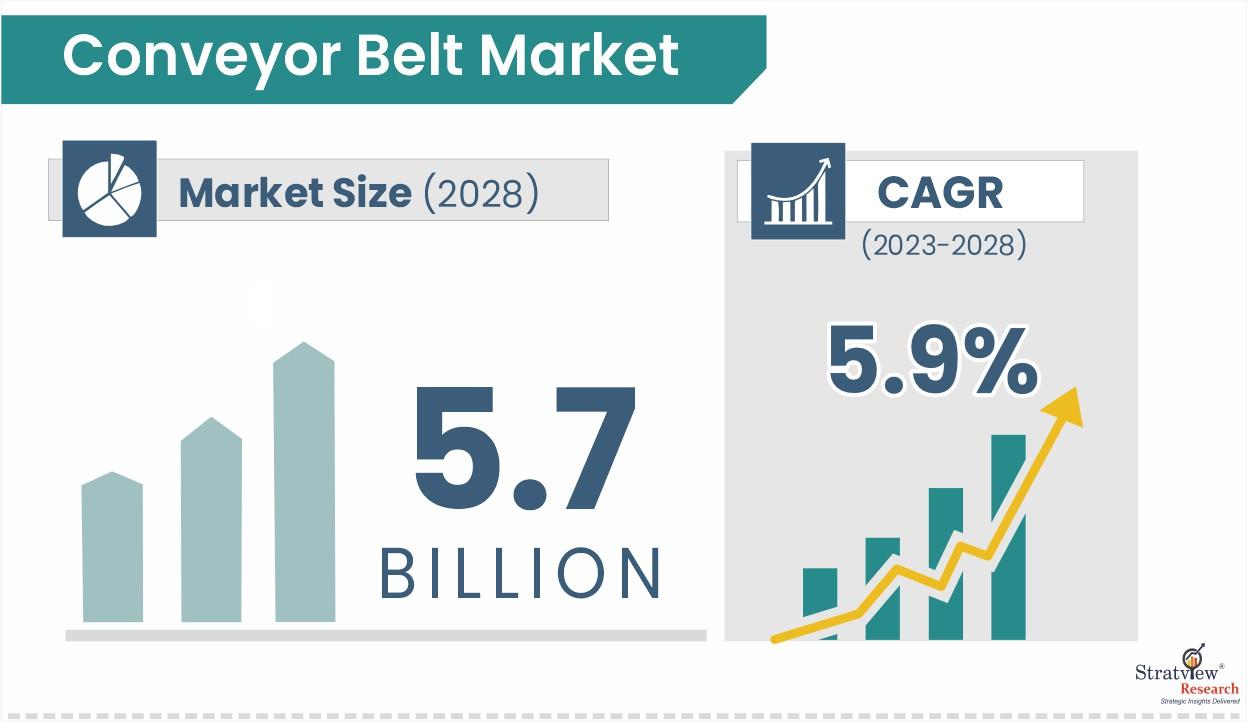
Conveyor belts—used for transporting materials in mines, factories, distribution centres, infrastructure projects etc.—play a critical role in industrial logistics. A Stratview Research report estimates the global conveyor belt market to grow to USD 5.7 billion by 2028, at a CAGR of ~5.9% over 2023-2028.
Click here to get a free sample of the report:
https://stratviewresearch.com/Request-Sample/3126/conveyor-belt-market.html#form
Drivers
- Industrialization & growth in manufacturing capacity: As companies expand production, build new factories or upgrade existing ones, conveyor belts are needed to move raw materials, parts, and finished goods more efficiently.
- Government infrastructure & smart city projects: Urbanization pressures and government investment in infrastructure (roads, metros, buildings, cement production) especially in emerging economies are a big boost for conveyor belt demand.
- Mining, cement & heavy materials sector: These sectors inherently rely on bulk material movement; increases in resource extraction, cement use, and raw material processing all require enhanced conveyor belt systems.
- Logistics, warehousing & food processing growth: As e-commerce, cold chain, food processing, packaging industries expand, there is rising need for conveyor systems for sorting, packaging, conveying-within-plants etc., which helps the conveyor belt market.
Trends
- Belts with higher performance (abrasion, durability, energy savings): Because many industries use belts under harsh conditions (abrasive material, steep angles, high loads), materials and construction that improve belt life and reduce energy losses are increasingly preferred.
- Flat belts dominate but special belts growing: Flat belts continue to dominate product types; however, modular belts, cleated belts, specialty belts (for special inclines or food-grade or wash-down environments) are becoming more common in specific sectors.
- Medium-weight belts widely used: Medium-weight belts are expected to dominate by weight class (balance of load capacity vs cost) across multiple end-use industries.
- Increasing automation & smart monitoring: There is rising interest in integrating sensors, IoT, predictive maintenance, better safety features in conveyor belt systems. This reduces downtime and improves operational efficiency.
- Growing regional investment and localized manufacturing: In Asia-Pacific, many countries are investing in local capacity and supply chain for conveyors and belts. Lower labor cost, raw materials availability, infrastructure needs drive this regional growth.
Conclusion
Overall, the conveyor belt market is poised for solid growth in the coming years — reaching ~US$5.7B by 2028, driven by industrial expansion, infrastructure, mining, and materials handling needs. The CAGR of ~5.9% indicates that although the market is mature, there is still substantial room for innovation and growth particularly in performance, durability, customization, and automation.
Firms that invest in higher-quality materials, energy-efficient and long-life belts, strong maintenance service offerings, and that align with regional infrastructure and industrial policy will likely benefit most. Those failing to improve durability or keep up with evolving requirements (e.g. incline belts, abrasion, automated monitoring) may be left behind. For companies and investors, the conveyor belt market remains a foundational industrial component with predictable demand and opportunity.
