
Inside Photoresists: Where the Growth Will Come From (Materials, Apps, and Regions)
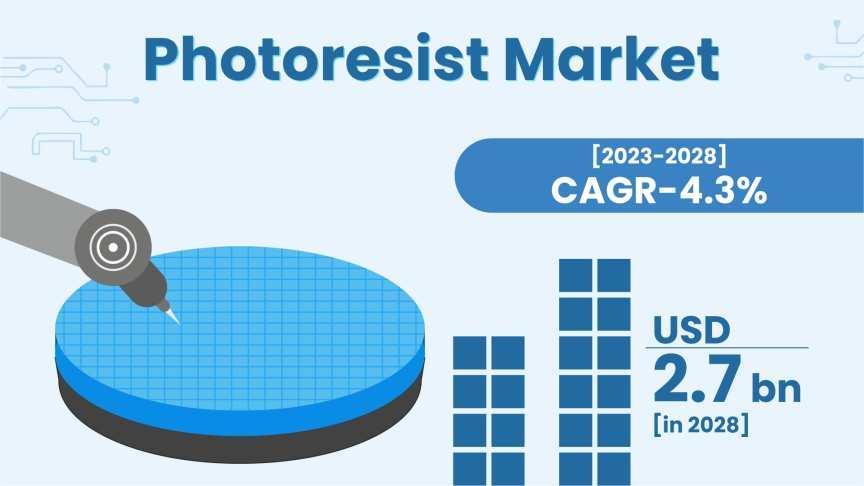
Stratview Research’s latest Photoresist Market analysis details a finely segmented landscape: materials (EUV, ArFi, ArF, KrF, G- & I-line), applications (logic, memory, DAO), end uses, and regions. Headline outlook: US$2.7 billion by 2028, 4.3% CAGR. A companion Stratview report on photoresist & ancillaries provides additional context on developer, remover, and anti-reflective coating needs across semiconductors, LCDs, and PCBs.
Request a sample report to preview our in-depth analysis:
https://www.stratviewresearch.com/Request-Sample/3666/photoresist-market.html#form
Drivers
1) Layer counts and complexity. Advanced logic stacks add layers and tighter specs, increasing resist consumption per wafer and pushing demand for robust EUV/ArFi chemistries with better line-edge roughness and sensitivity.
2) Ubiquitous semiconductors. From automotive ADAS to industrial automation, growth in non-consumer segments broadens the base for DAO and power devices—areas still well-served by KrF and G/I-line resists at mature nodes.
3) Regional capacity build. Ongoing fab investments across East Asia—and spillover activity in the US/EU—sustain both leading-edge and mature-node demand; Stratview expects APAC to stay largest and fastest-growing.
Trends
Material hierarchy:
- KrF = volume anchor in 2028, reflecting steady demand in automotive, power, and sensor ICs.
- EUV = fastest growth, tied to leading-edge logic/memory roadmaps and patterning shifts.
- ArFi/ArF = workhorses across many high-precision layers where EUV is not yet economical or needed.
Application outlook: Logic remains the largest pool of demand, benefiting from AI-centric compute and 5G devices; memory demand cycles with capex but benefits from higher density and emerging architectures; DAO remains resilient through diversified electronics end markets.
End-use cadence: Computer is the top end-use, while communication leads growth—mirroring bandwidth needs from cloud to edge.
Ancillaries interplay: In parallel, Stratview’s ancillaries report highlights anti-reflective coatings as the leading ancillary and I-line as a dominant photoresist type in those broader markets (including LCDs/PCBs), underscoring how mature-node and display/PCB demand keeps legacy wavelengths relevant.
Competitive landscape: An experienced cohort—JSR, TOK, Shin-Etsu, Merck, DuPont, Sumitomo Chemical, Fujifilm, Allresist—competes on finely tuned formulations, defectivity control, and close application engineering with fabs.
Conclusion
Near term, growth is a tale of two speeds: EUV-driven layers at the cutting edge and KrF/G-I line durability at mature nodes and in displays/PCBs. With APAC in the lead and logic the biggest sink for advanced resists, vendors that span the wavelength spectrum—and pair it with strong process support and ancillary ecosystems—are best positioned to capitalize on a market Stratview sizes at US$2.7 billion by 2028.
