
Inside the IR Stack—What’s Powering the Next Wave of Adoption
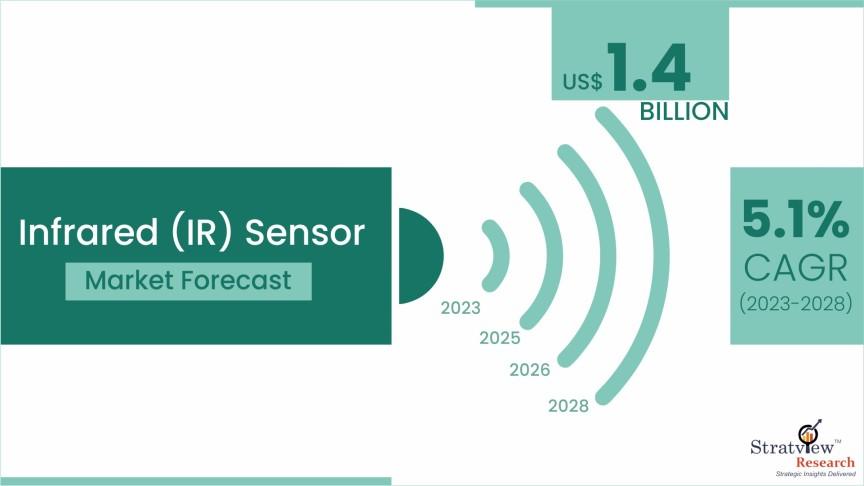
From contactless temperature checks to night-time situational awareness, infrared sensing enables actions that visible-light systems can’t match. Stratview Research sizes the infrared sensor market on a steady trajectory—5.1% CAGR for 2023–2028—reaching roughly USD 1.4 billion by 2028 as industries prioritize automation, safety, and smart functionality.
Download the sample report here:
https://stratviewresearch.com/Request-Sample/3373/infrared-sensor-market.html#form
Drivers
Multi-industry automation remains the core driver. Thermal imagers and detectors deliver non-contact, precise readings of heat and motion, streamlining inspection, predictive maintenance, and fire/gas safety. Stratview points to this cross-sector automation push—spanning industrial plants, aerospace assets, and vehicles—as a durable source of demand.
Security & public safety add structural pull. Whether mounted on perimeter towers, helmets, or drones, IR systems give responders and operators the ability to monitor environments through darkness, smoke, or adverse weather—raising the floor on situational awareness. With compact, uncooled options proliferating, procurement is expanding beyond elite units to mainstream deployments.
Consumer & building ecosystems reinforce volume. In phones, wearables, and home devices, IR supports proximity sensing, face authentication, and smart-lighting triggers; in buildings, it enables occupancy-aware HVAC and energy optimization. These everyday uses create a large, distributed sensor base that compounds annually.
Trends
Product mix evolution. Stratview’s segmentation shows thermal imagers as the current leader, prized for high-sensitivity imaging across defense and commercial thermography/surveillance; thermal detectors are the fastest-growing thanks to lower cost and broad fit for temperature and motion sensing. Together, they open distinct price-performance lanes for OEMs.
Application breadth. On the detector side, growth spans position & motion detection, gas & fire detection, smart building, spectroscopy, people counting, and HVAC. On the imager side, demand splits between military (thermal weapon sights, soldier vision) and commercial (thermography, surveillance, personal vision systems, firefighting, ruggedized smartphones)—a portfolio that de-risks cycles.
Regional concentration with APAC out front. Asia-Pacific both leads and grows fastest, supported by extensive electronics manufacturing and an expanding defense/industrial base. Stratview names key regional suppliers—including Murata, NICERA, Wuhan Guide Sensmart, Global Sensor Technology—illustrating why APAC will remain the gravitational center for production and adoption.
Competitive dynamics. The field is consolidated at the top with players such as Teledyne, Excelitas, Lynred, Murata, Melexis, Heimann Sensor, Seek Thermal, Wuhan Guide Sensmart, and Global Sensor Technology—all competing on sensitivity, size, cost, and channel footprint. M&A (e.g., Teledyne–FLIR) underscores the value of scale and vertical integration across sensors, modules, and systems.
Conclusion
Infrared sensing is moving deeper into everyday operations—industrial automation, public safety, and connected living—because it delivers reliable data where visible-light approaches fail. Stratview’s outlook to ~USD 1.4 billion by 2028 (5.1% CAGR) reflects a balanced market: imagers dominating high-spec imaging; detectors accelerating in cost-sensitive sensing. With Asia-Pacific leading, vendors that tune portfolios to specific applications, secure resilient supply chains, and support customers from evaluation to fleet-wide deployment will capture the next wave of growth.
